




















For the first time in more than 50 years, humans have traveled beyond low Earth orbit and returned safely.
NASA’s Artemis II mission, which launched on April 1, 2026 at 6:35 p.m. EDT, carried four astronauts on a nearly 10-day journey around the Moon and back, covering 694,481 miles. It marked the first crewed mission to deep space since Apollo 17 in 1972 and proved that human exploration beyond Earth orbit is no longer just history. It is happening again.
This mission did not include a lunar landing, but that was never the goal. Artemis II was about testing everything that has to work before astronauts can step back onto the Moon. And by the time the Orion spacecraft splashed down safely in the Pacific Ocean off San Diego on April 10, it had done exactly that.
The mission began at Kennedy Space Center, where NASA’s Space Launch System lifted off from Launch Complex 39B. Within the first hour, Orion’s solar array wings deployed successfully, giving the spacecraft the power it needed for the journey ahead. Once in space, Orion completed system checks before leaving Earth orbit and beginning its flight toward the Moon.
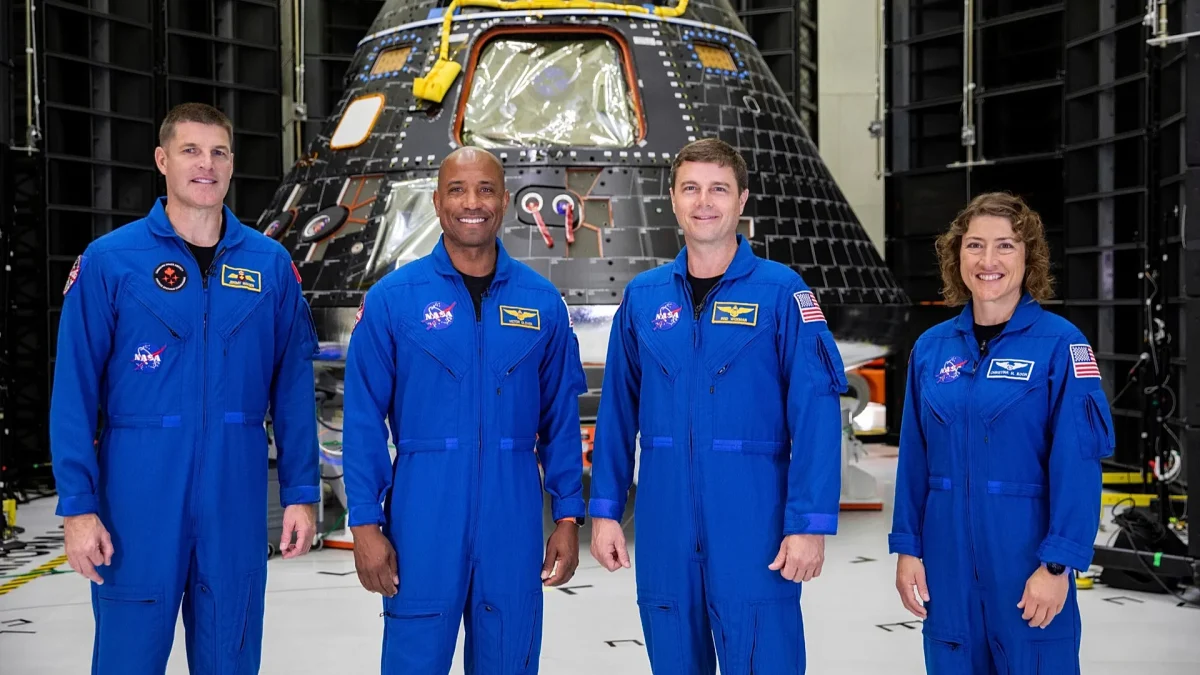
On board Orion, named Integrity, were four astronauts: Reid Wiseman, Victor Glover, Christina Koch, and Jeremy Hansen of the Canadian Space Agency. The crew also made history individually. Glover became the first Black astronaut on a lunar mission, Koch became the first woman on a lunar mission, and Hansen became the first non-American to travel beyond low Earth orbit.
As Orion moved farther from Earth, the mission became more than just a technical test. NASA reported that the crew broke the record for the farthest human spaceflight when they passed 248,655 miles from Earth, later reaching about 252,756 miles before looping back home. That means Artemis II carried humans farther away than even Apollo 13, which had held the record since 1970.
The spacecraft followed a free-return-style path, using gravity to help guide Orion around the Moon and back toward Earth. That part matters because space travel is not just about going fast. It is about having a safe path if something goes wrong. Artemis II showed that Orion could handle deep-space navigation, communication, life support, and crew operations with real astronauts aboard.
The most dramatic moment came when Orion flew around the Moon. The crew saw the lunar surface up close and Earth from a distance that almost no humans have ever experienced. That kind of view is hard to even imagine: the Moon below, deep space around them, and Earth looking small and fragile in the distance.
But the return was probably the biggest test. Orion came back through Earth’s atmosphere traveling nearly 35 times the speed of sound, with NASA reporting reentry speeds around 24,664 mph. The spacecraft’s thermal protection system had to protect the crew from extreme heating during reentry. Initial NASA inspections found that the heat shield performed as expected, with no unusual conditions identified.
Splashdown happened in the Pacific Ocean off the coast of San Diego, where NASA and the U.S. Navy recovered the crew and spacecraft. From the outside, it may have looked simple: a capsule in the water and astronauts coming home. But really, that moment represented years of planning, testing, engineering, and risk.
Artemis II proved that humans can travel beyond low Earth orbit again. It proved Orion can support a crew in deep space. It tested the systems needed for future Moon missions. Most importantly, it cleared the way for what comes next: Artemis III and the return of astronauts to the lunar surface.
For decades, deep space exploration felt like something from old Apollo footage and history textbooks. Artemis II changed that. It did not land on the Moon, but it proved NASA is ready to go back.
And this time, the goal is not just to visit.
It is to stay.